
Table of the Panchachakras, 2026
Explore Each Chakra
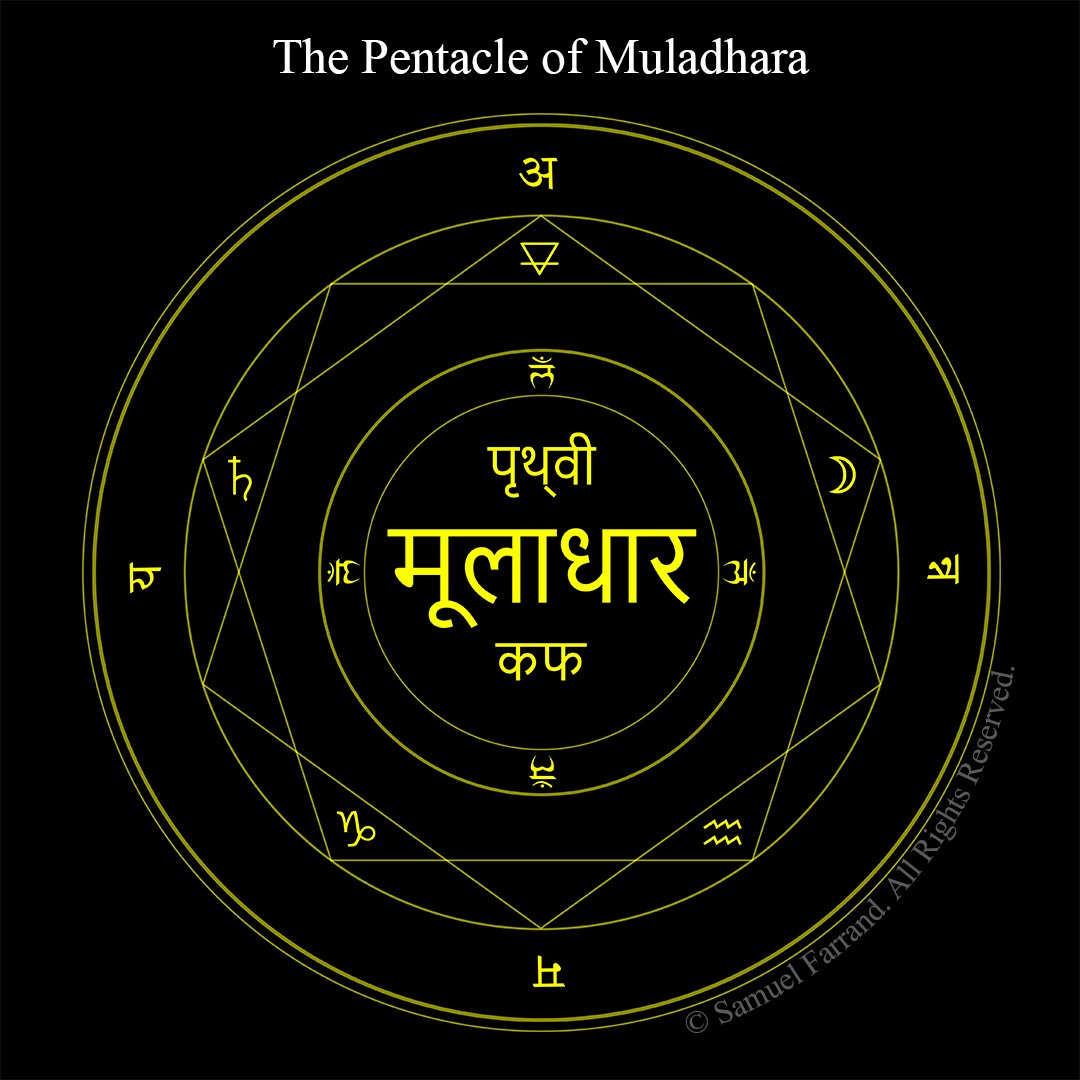
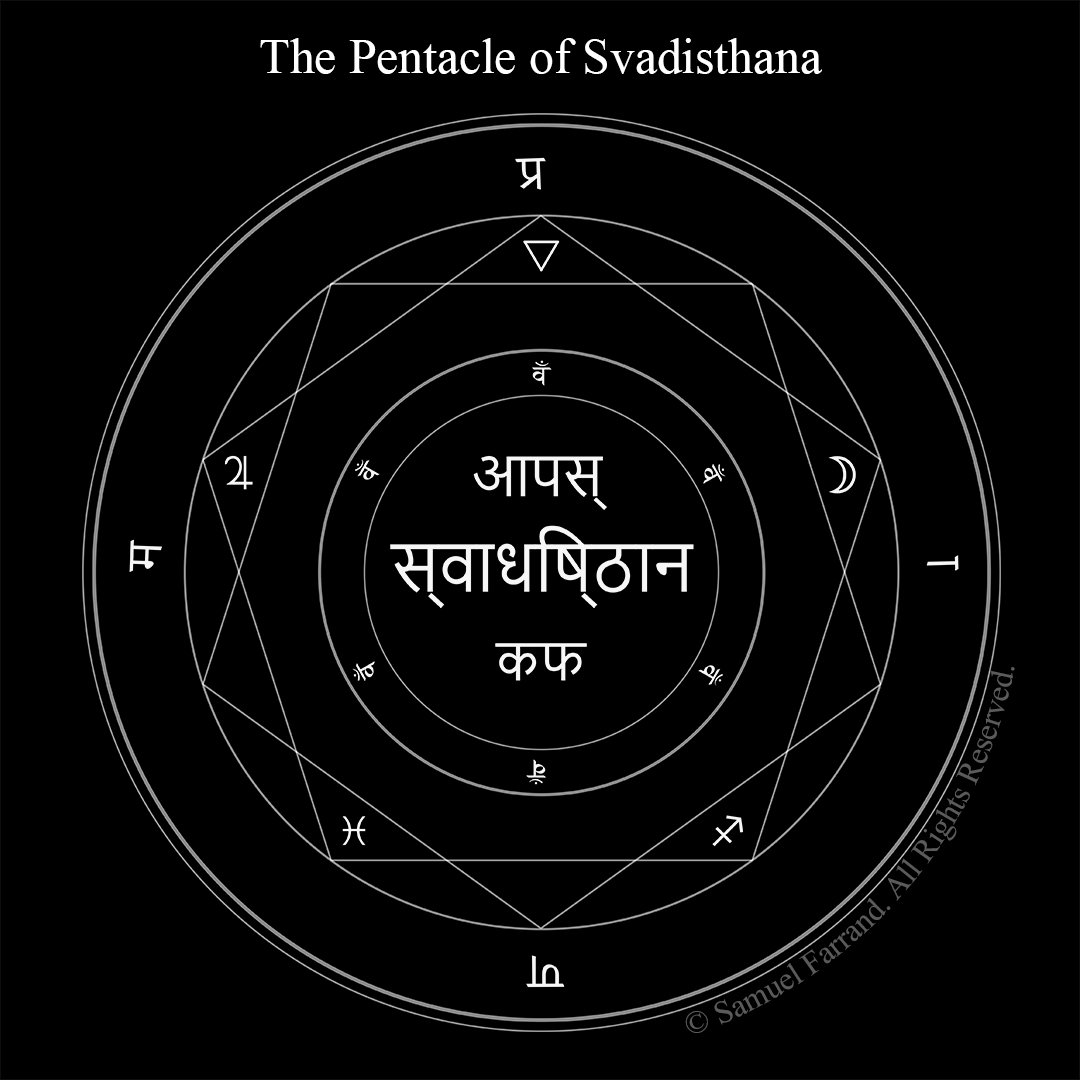
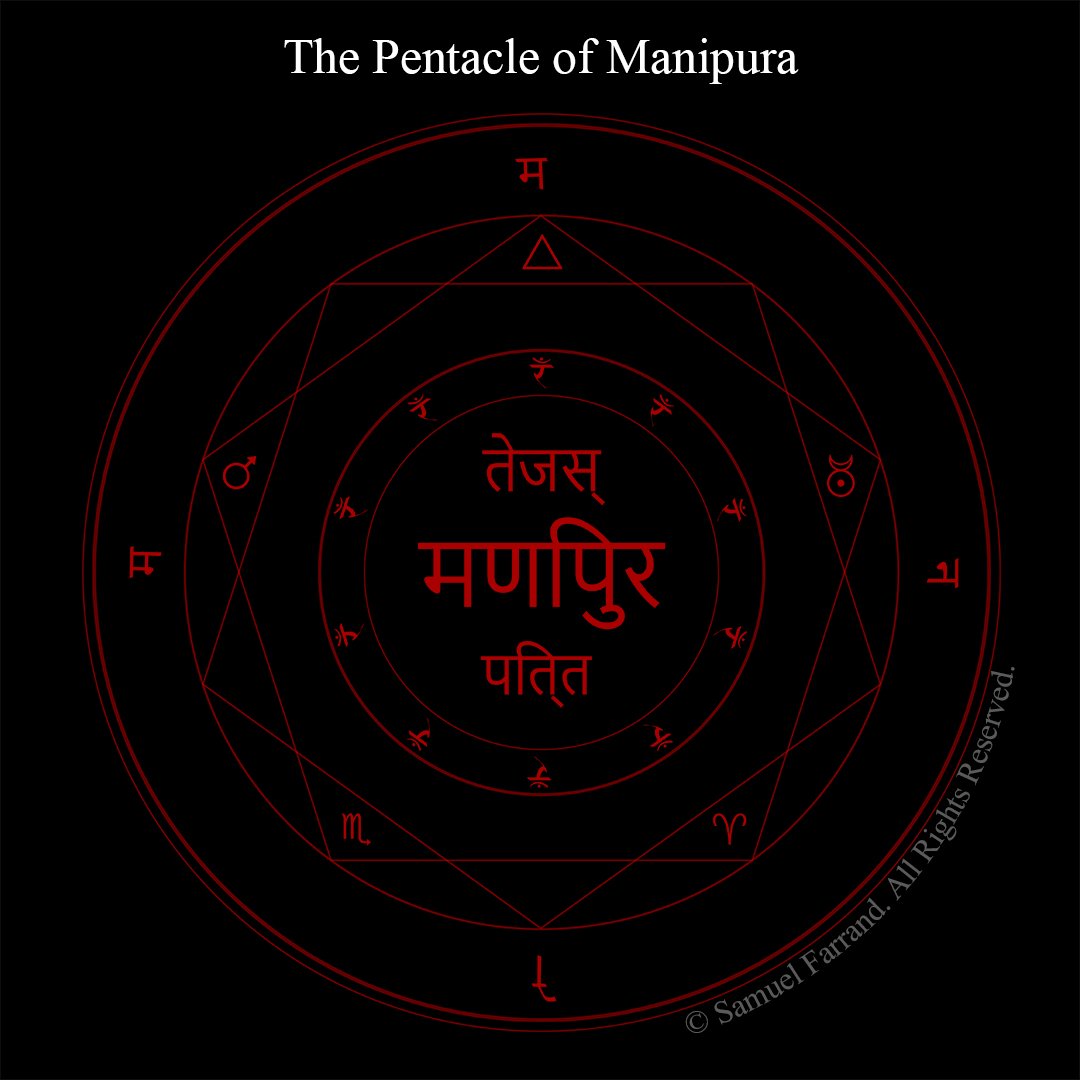
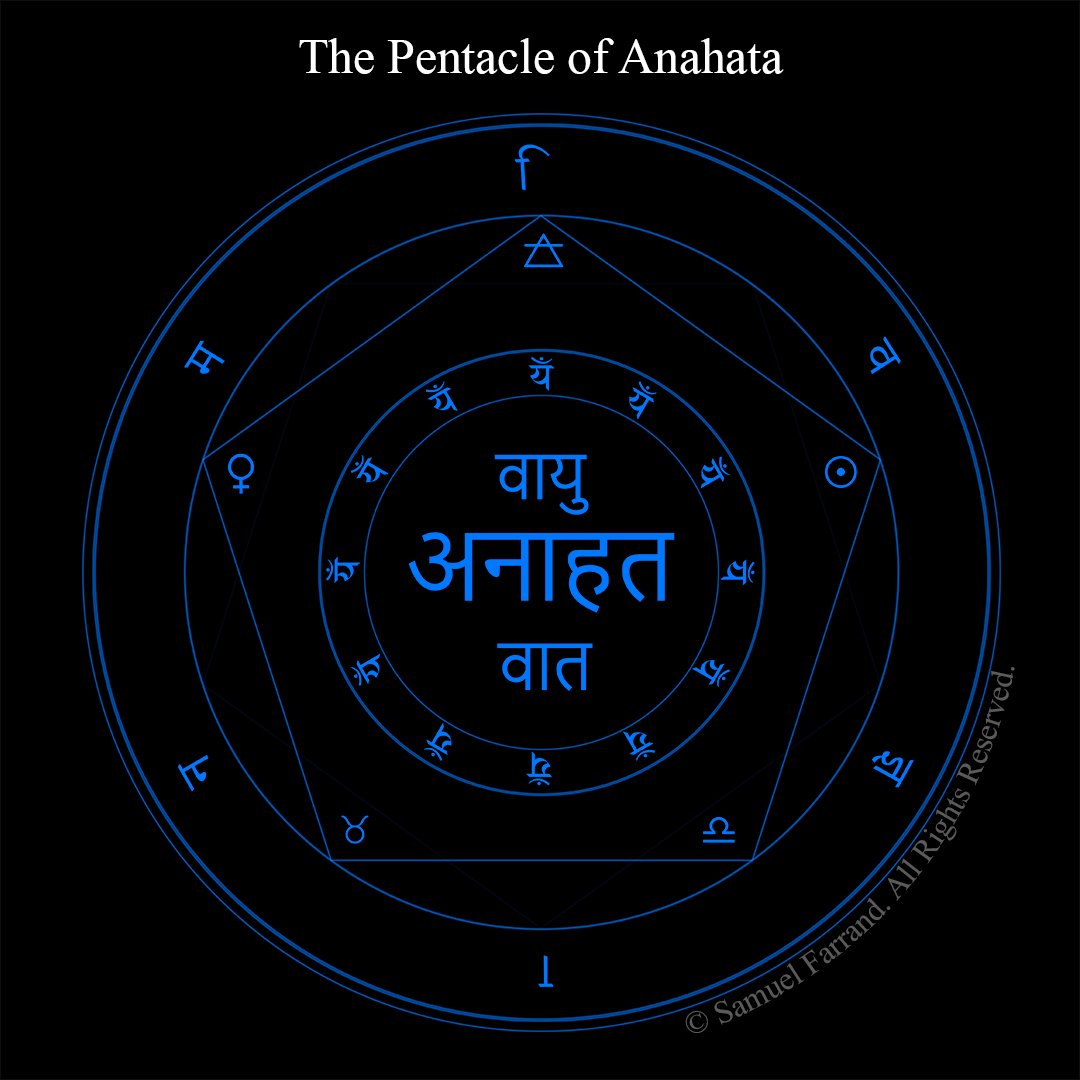
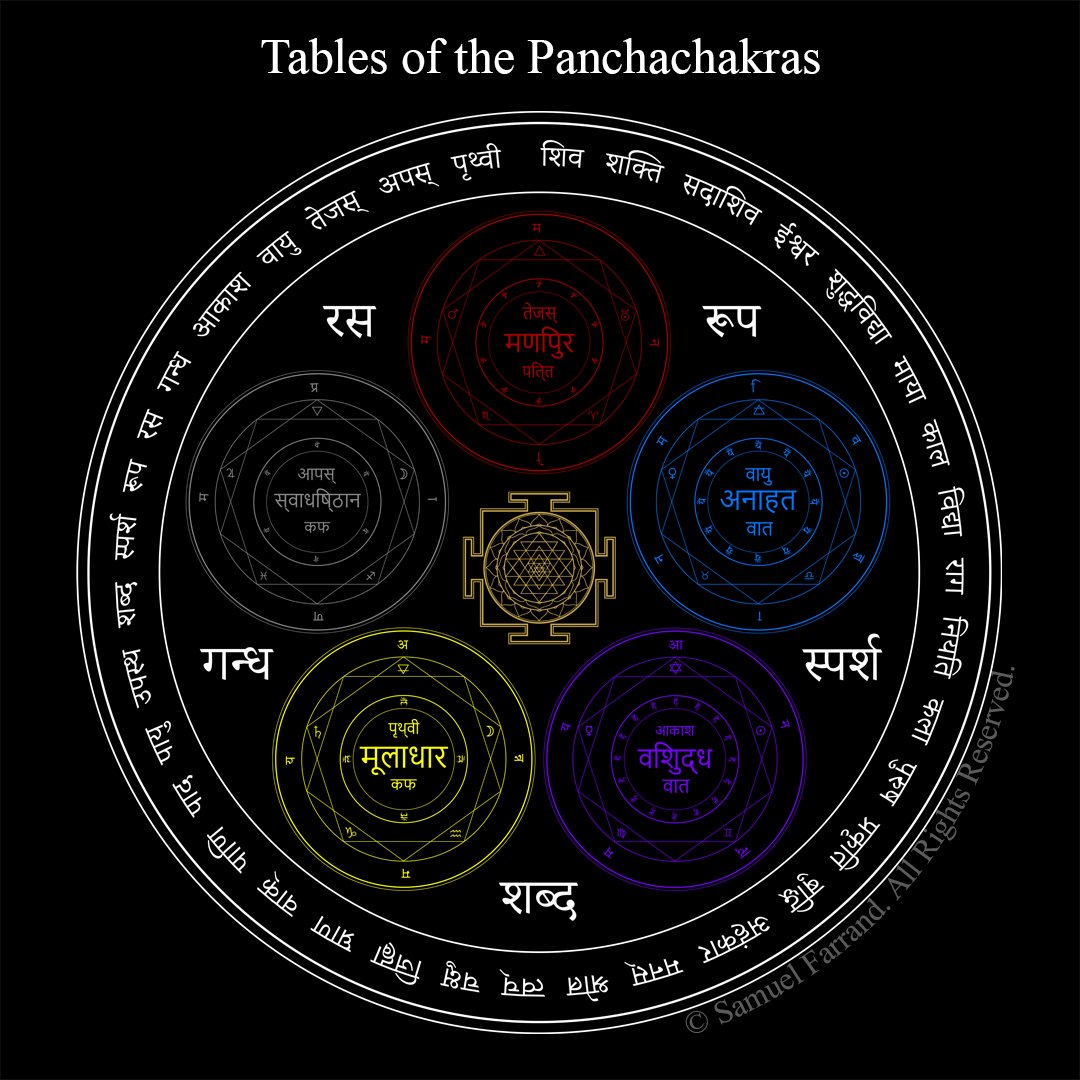
The Table of the Panchacakras is a cosmological map, a unified correspondence system drawing from some of the oldest and most rigorous philosophical traditions in human history, threading them into a single coherent visual language. The central question it answers is one the esoteric traditions of both East and West have always circled: what is the relationship between pure consciousness and gross material existence, and how does one descend into the other?
The composition operates across three spatial zones, each representing a distinct tier of reality. At the outermost boundary, the 36 Tattvas of Kashmir Shaivism encircle the entire diagram as a textual emanation sequence, naming the full descent from pure Shiva consciousness down to gross earth. In the middle field, five individual chakra seals each represent one of the five classical chakras of the original Hindu Tantric system, color-coded according to the Tattva elemental tradition and loaded with layered correspondence data. At the very center, the Sri Yantra sits as the geometric heart of the composition, the visual compression of the same emanation process the outer ring describes in language. In the five spaces between the chakra seals, the five Tanmatras, the subtle elemental essences that are the immediate precursors to the five gross elements, are placed as the invisible substrate between visible forms. Together these zones form a complete statement: reality begins as pure undifferentiated consciousness, passes through increasingly complex layers of manifestation, and arrives finally as the gross elements that constitute physical existence.
The Outer Ring: The 36 Tattvas as Cosmological Container
The word Tattva derives from the Sanskrit tat, meaning ‘that,’ and tvam, meaning ‘thou.’ A Tattva is a principle of reality, a fundamental category of being. The Tattva system has its philosophical roots in Samkhya, one of the six classical schools of Indian philosophy, dating to roughly 700 to 500 BCE. Kashmir Shaivism, the non-dual Tantric tradition that forms the philosophical backbone of this composition, expanded the Samkhya model to 36 Tattvas, adding above the material principles a tier of five pure consciousness principles and seven limiting principles that describe the process by which pure Shiva consciousness contracts itself into the appearance of individual, limited existence. This contraction is the divine act of self-concealment through which the infinite plays at being finite, the one pretends to be many, and pure awareness dreams the world into being.
Placing all 36 Tattva names in Devanagari script around the outermost ring transforms the boundary of the seal into a living emanation sequence. Reading from the top, Shiva at the apex, the viewer follows the full arc of divine self-manifestation from pure consciousness down through the limiting principles, the instruments of mind and sense, the subtle elemental essences, and finally the five gross elements whose names appear at the base of the ring. Those five gross elemental names, Akasha, Vayu, Tejas, Apas, Prithvi, are the same five principles that govern the five chakra seals within. The outer ring is the genealogy of the inner seals. It tells the story of how the five chakras came to be.
The spacing of three gaps between each Tattva name was intentional in its rigor and generous in its result. Thirty-six names with three spaces between each produces 108 total space units in the outer ring. In Hindu, Buddhist, and Jain traditions alike, 108 is among the most sacred of numbers. There are 108 beads on a mala, 108 Upanishads in the Vedic canon, 108 names of the goddess, and the distance between the Earth and Sun is approximately 108 solar diameters. The geometry of a rigorous correspondence system generating this number organically is evidence of the internal coherence of the underlying symbolic structure.
The Five Chakra Seals
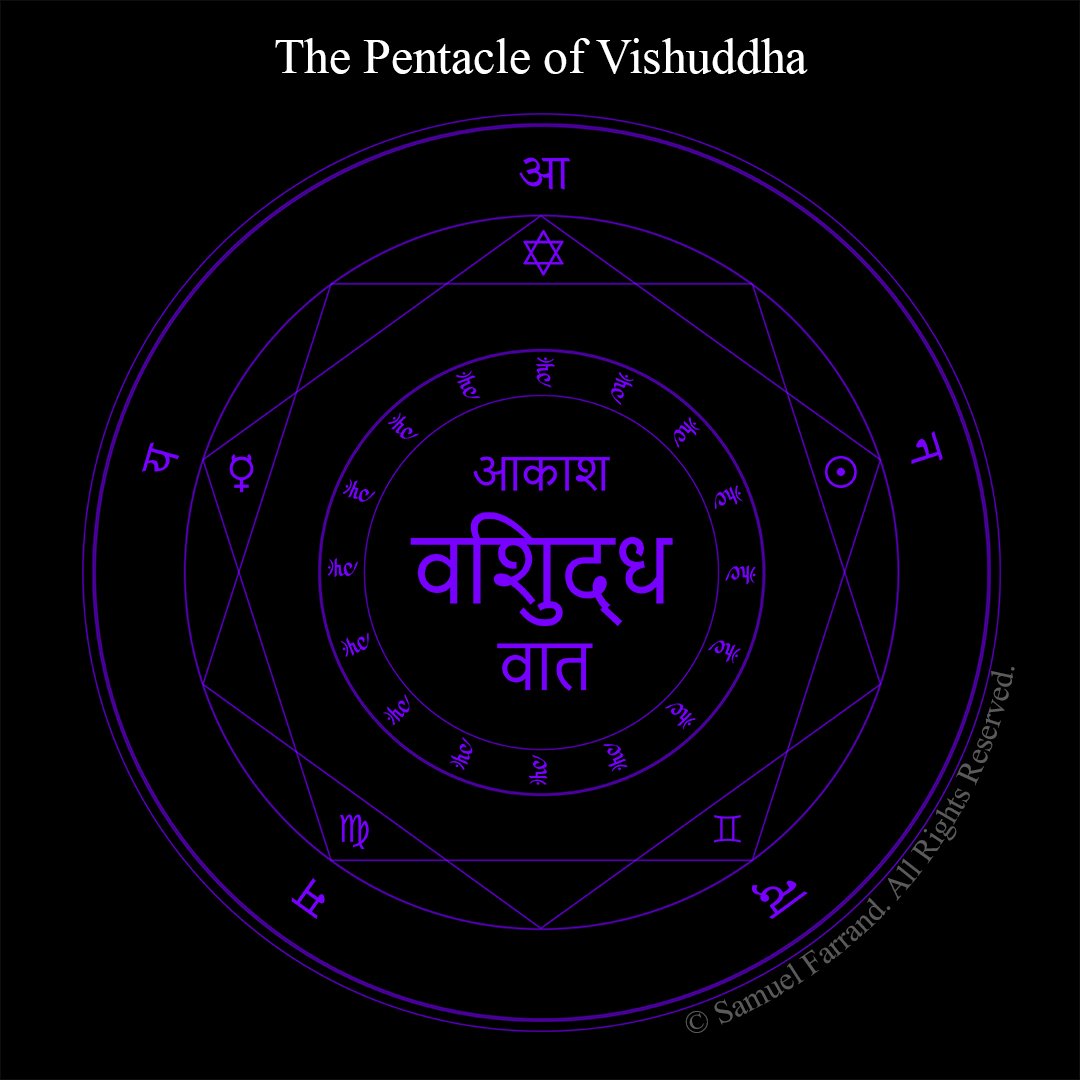
The five chakra system appears in early Shaiva Tantric sources from roughly 600 to 900 CE and maps with elegant precision onto the five classical elements of Pancha Mahabhuta. Each of the five chakras governs one element, one Tattva, one classical planet, one dosha from Ayurvedic medicine, and one Kosha from Upanishadic philosophy. Every layer reinforces and illuminates every other layer.
Each chakra seal is rendered in the color of its governing Tattva symbol. The Tattva elemental symbols, Prithvi as a yellow square, Apas as a silver crescent, Tejas as a red upward triangle, Vayu as a blue circle, and Akasha as a black oval, carry ancient roots in Samkhya and Tantric tradition and were adopted by the Western Hermetic tradition through the Hermetic Order of the Golden Dawn in the 1880s as tools for elemental meditation and astral work. The resulting color sequence, yellow, silver, red, blue, and indigo-black, follows elemental logic. The Tattva colors emerge from within the tradition itself, carrying the full symbolic and historical weight of the systems they represent.
The Planetary Assignments and the Two Luminaries
The five classical planets, Saturn, Jupiter, Mars, Venus, and Mercury, are assigned one to each chakra. Saturn governs Muladhara as the planet of density, contraction, and the weight of matter. Jupiter governs Svadhisthana as the planet of expansion, abundance, and the generative principle. Mars governs Manipura as the planet of drive, fire, and autonomous will. Venus governs Anahata as the planet of love, beauty, and relational consciousness. Mercury governs Vishuddha as the planet of language, mediation, and the transmission of meaning between worlds.
The Sun and Moon govern the composition through the nature of conscious experience itself. The lower two chakras, Muladhara and Svadhisthana, operate in the domain of instinct, survival, generation, and subconscious process. These are dense, inward, primordial experiences that the self finds itself already immersed in before awareness arrives. This is lunar territory: the realm of the subconscious, of tidal forces, of what moves in us before we are aware of it moving. Manipura stands as the bridge and transformer, the crucible in which instinctual energy is metabolized into conscious direction, the fulcrum where one mode of experience becomes another. The heart and throat govern conscious outward experience. Love as a chosen orientation toward another. The spoken word as the deliberate transmission of inner meaning into outer form. These are solar experiences: radiating, illuminating, directed outward from a self that is present to itself. The arc across the five chakras reads from subconscious density below through autonomous will at the center to conscious expression above.
The Tanmatras: The Subtle Ground Between Forms
In the five spaces between the chakra seals sit the five Tanmatras, the subtle elemental essences occupying the tier immediately above the gross elements in the Samkhya and Kashmir Shaivite emanation hierarchy. The Tanmatras are the subtle qualities of experience from which the gross elements crystallize: Gandha, smell, for Earth; Rasa, taste, for Water; Rupa, form and sight, for Fire; Sparsha, touch, for Air; and Shabda, sound, for Ether.
The sequence moves from the most dense and instinctual sense at the root to the most subtle and universal at the throat. Smell is the sense most directly tied to survival, memory, and the subconscious body. Sound operates at the boundary between the physical and the immaterial, able to carry meaning across distance and darkness. Placing the Tanmatras in the gaps between the gross element seals means the spaces between forms contain the subtle origins of those forms. The visible is surrounded by the invisible that produced it.
The Sri Yantra: Geometric Heart of the Emanation
At the center of the composition sits the Sri Yantra, the most complex and revered geometric symbol in the Hindu Tantric tradition, associated with the goddess Tripura Sundari and the Sri Vidya tradition. It is understood as her body, the geometric form of reality itself as consciousness experiencing itself.
The classical Sri Yantra consists of nine interlocking triangles generating 43 smaller triangles that map the full spectrum of cosmic manifestation. Surrounding the triangle complex are two rings of lotus petals representing the subtle Shaktis of speech and the lunar aspects of manifestation. Three concentric circles represent the three Gunas, the fundamental qualities of Prakriti: Tamas, Rajas, and Sattva. The outermost boundary is the Bhupura, the square earth-ground with four gates opening to the four cardinal directions.
Every structural layer of the Sri Yantra corresponds to a principle already present in the outer ring of 36 Tattvas. The nine triangle complex maps the upper Shiva and Shakti Tattvas. The lotus rings correspond to the Jnanendriyas and the lunar principle of Soma. The three Guna circles correspond to Prakriti, Tattva 13, the primordial matter from which all subsequent principles evolve. The Bhupura gates correspond to the four gross elemental chakras of the inner field. Text on the circumference, geometry at the heart, the two modes of the same statement holding each other.
The Sri Yantra is rendered in antique gold against the black void of the central field, the most historically authenticated color for this symbol across the Shakta tradition. Gold emerging from black is the visual language of consciousness emerging from the void, the first movement of Shiva into Shakti, the first Tattva descending into the second.
The Synthesis
This composition was built from the inside out. The foundational layer is the five chakra system with its five Tattvas and five planets. Every subsequent layer was chosen because it extends the logic of that foundation. The doshas are the biological expression of the Tattvas. The Koshas are the consciousness sheaths mapped onto the same elemental progression. The zodiacal assignments follow the planetary assignments through classical essential dignities. Each layer is a translation of the same underlying principle into a different symbolic vocabulary. The traditions represented here arrived at structural agreement independently, across centuries and continents, and the Table of the Panchacakras holds the points where they converge.
Conclusion: The Map as Practice
The Table of the Panchacakras is designed to be read as a complete statement. Beginning at the center with the Sri Yantra, the contemplative mind rests in the geometric image of pure consciousness in its creative act. Moving outward to the five chakra seals, it encounters the five faces of elemental reality as they manifest in the human body, the energetic system, the biological constitution, and the sheaths of the self. Moving to the outermost ring, it encounters the full genealogy of those five faces, tracing the 36 steps by which Shiva became earth, by which the infinite became the finite, by which consciousness became matter.
Reading inward from the outer ring reverses the process. From Prithvi at the base, through the ascending Tattvas, through the five elemental chakras, into the geometric heart of the Sri Yantra and its central bindu point, the mind traces the path of return. This is the path the contemplative traditions of both East and West have always described: the ascent from gross matter through increasingly subtle layers of reality back to the pure awareness that was never actually absent, only apparently concealed. The Table of the Panchacakras is a map of that journey.
Explore more from this series →

Leave a Reply