Magickal Diagrams: Da’irat al-Wujud
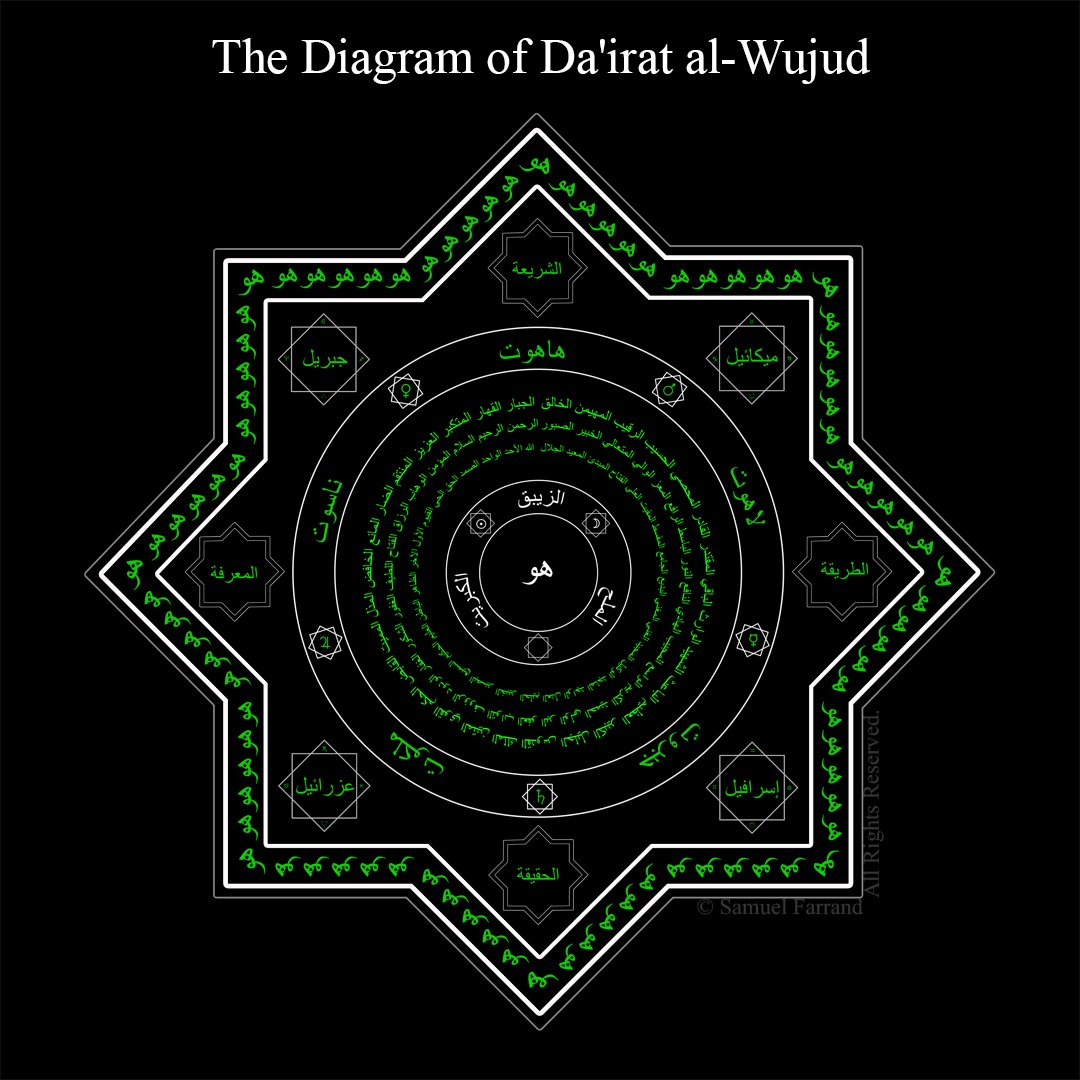
At the absolute center of this diagram is a single Arabic pronoun — هو, Hu, meaning “He” — the most intimate and most ineffable of the divine designations in Islamic mystical tradition. It is not a name. It is not an attribute. It is the pure pointing of consciousness toward the Absolute before language can form a concept around it. Everything in Da’irat al-Wujud radiates outward from that silent center, and everything in it is ultimately a commentary on that one syllable.
The diagram is constructed as a complete map of Sufi cosmology, drawing primarily from the metaphysical system of Muhyiddin Ibn Arabi, the 13th century Andalusian mystic whose work Fusus al-Hikam and Al-Futuhat al-Makkiyya remain the most comprehensive articulations of Islamic esoteric cosmology ever written. Ibn Arabi’s central doctrine — wahdat al-wujud, the Unity of Being — holds that all existence is a single reality manifesting through infinite degrees of self-disclosure. Da’irat al-Wujud is a visual rendering of that doctrine, translating metaphysical structure into geometric form using the sacred visual language of Islamic art.
The Architecture of Emanation
Immediately surrounding Hu is the Barzakh — the isthmus, the liminal threshold that exists between the divine and the created, between what can be named and what cannot. In Ibn Arabi’s cosmology Barzakh is not a place but a condition — pure liminality, the boundary that separates two seas without belonging to either. In this diagram Barzakh is encoded through the three alchemical primes — الزيبق Al-Zaybaq (Mercury), الكبريت Al-Kibrit (Sulphur), and الملح Al-Milh (Salt) — the primordial triadic structure through which unity first differentiates into creative principle. Al-Kibrit in particular carries extraordinary weight in the Sufi tradition — Ibn Arabi uses al-kibrit al-ahmar, the red sulphur, as a metaphor for the supreme hidden secret, the rarest spiritual substance. Its placement at the threshold of the Absolute is deliberate and precise.
Flanking Hu at the innermost ring are the two great luminaries — the Sun and Moon — held within Rub el Hizb frames, the eight-pointed star that serves as the traditional division marker of the Holy Quran. In Islamic cosmology the Sun and Moon represent the two poles of divine light — active and receptive, jalal and jamal, majesty and beauty. Ibn Arabi himself uses the relationship between Sun and Moon as a direct analogy for Barzakh — the liminal space between day and night, between light and shadow, is the isthmus made visible in the natural world.
The Ninety-Nine Names
Radiating outward from Barzakh in three concentric rings are the Asma ul Husna — the 99 Most Beautiful Names of Allah. Rather than arranging them as a single undifferentiated band, Da’irat al-Wujud organizes them according to the classical Sufi triadic division of divine qualities. The innermost ring carries the Names of Kamal — Perfection — those Names that transcend and synthesize all divine qualities: Al-Ahad, Al-Samad, Al-Haqq, Al-Hayy, Al-Qayyum. The middle ring carries the Names of Jamal — Beauty — the gentle, merciful, receptive Names: Ar-Rahman, Ar-Rahim, Al-Latif, Al-Wadud. The outermost Names ring carries the Names of Jalal — Majesty — the awesome, overwhelming, transformative Names: Al-Jabbar, Al-Qahhar, Al-Mutakabbir. This triadic arrangement mirrors the three alchemical primes at the center — Salt as synthesis, Mercury as receptivity, Sulphur as transformative fire — creating a structural echo between the innermost and middle layers of the diagram.
The Five Divine Presences
Beyond the Names lies the ring of Al-Hadarat al-Ilahiyya — the Five Divine Presences — the cosmological framework through which Ibn Arabi maps the complete spectrum of existence from the Absolute to the material world. Reading outward from the center: Hahut, the Presence of the pure divine Essence; Lahut, the Presence of the divine Attributes; Jabarut, the Presence of divine Power and the spirits of prophets; Malakut, the Presence of the Imaginal and Angelic realm; and Nasut, the Presence of humanity and the material world. Dividing these five Presences on the ring are five Rub el Hizb markers, each carrying one of the five classical planets of Islamic astronomy — Mercury, Venus, Mars, Jupiter, and Saturn — each planet governing its corresponding Presence as a celestial mediator between the divine and the manifest. The descent from Saturn at Hahut to Mercury at Nasut encodes the Neoplatonic celestial hierarchy that runs through the work of al-Kindi, Ibn Arabi, and the entire tradition of Islamic philosophical cosmology.
The Four Gates and Four Archangels
At the four cardinal points of the diagram stand the Four Gates of the Sufi path — the stations through which the seeker moves from the outer world inward toward the Absolute. To the North, الشريعة Ash-Shariah — the exoteric law, the foundation of all spiritual practice. To the East, الطريقة At-Tariqa — the spiritual path, the way of the Sufi orders. To the South, الحقيقة Al-Haqiqa — divine truth, the direct experiential knowledge of reality. To the West, المعرفة Al-Marifa — gnosis, the station of complete union with the divine. Each Gate is framed within a double-line khatam star — the eight-pointed star of Islamic sacred geometry — encoding the structured, architectural nature of the path itself.
At the four diagonal corners stand the four Archangels, each held within a Rub el Hizb frame and accompanied by their elemental triplicity of zodiac signs. جبريل Jibril, the Angel of Revelation, governs the Fire signs — Aries, Leo, Sagittarius. ميكائيل Mikail, the Angel of Sustenance, governs the Earth signs — Taurus, Virgo, Capricorn. إسرافيل Israfil, the Angel of Resurrection, governs the Air signs — Gemini, Libra, Aquarius. عزرائيل Azrail, the Angel of Death and Transition, governs the Water signs — Cancer, Scorpio, Pisces. The twelve zodiac signs distributed across four angelic guardians creates a unified celestial system in which the angels govern not only cosmic function but the entire belt of the manifest heavens.
The deliberate use of the khatam star for the Gates and the Rub el Hizb for the Angels encodes a visual grammar that runs throughout the diagram — the khatam as the symbol of structured, manifest order, the Rub el Hizb as the symbol of sacred celestial presence. The distinction is not merely aesthetic. It is ontological.
The Outer Boundary
The entire diagram is enclosed within a khatam star — the eight-pointed star formed by two overlapping squares that is perhaps the most fundamental symbol of Islamic sacred geometry. Its eight points correspond to the eight bearers of the Divine Throne described in Surah Al-Haqqah — the angels who carry the Arsh above all creation. The diagram is literally held within the Throne. Running along every edge of the outer star, repeating without beginning or end, is the invocation هو هو هو — Hu Hu Hu — the divine pronoun that also sits at the absolute center. The outermost boundary and the innermost point speak the same word. The Circle of Existence begins and ends in the same breath.
A Note on Synthesis
Da’irat al-Wujud draws from multiple streams of sacred knowledge — Sufi cosmology, Islamic astronomy, Quranic hermeneutics, and the Western alchemical tradition whose roots lie in the Arabic scholarship of Jabir ibn Hayyan and al-Razi. The inclusion of the three alchemical primes and the planetary and zodiacal glyphs alongside classical Arabic cosmological content is not syncretic decoration. It is a recognition that these traditions share a common root in the Neoplatonic and Hermetic currents that flowed through Andalusian Islamic scholarship — the same world that produced Ibn Arabi himself. In this sense Da’irat al-Wujud is not a fusion of traditions but a return to a moment before they diverged.
The work is entirely hand-constructed without the use of artificial intelligence, built from geometric first principles using the same tools and methods of the Islamic sacred art tradition — precision, repetition, and the understanding that geometry is not decoration but cosmology made visible.
Da’irat al-Wujud is an original work by Samuel Farrand. All rights reserved.