
Table of the Ogham Aicme’s
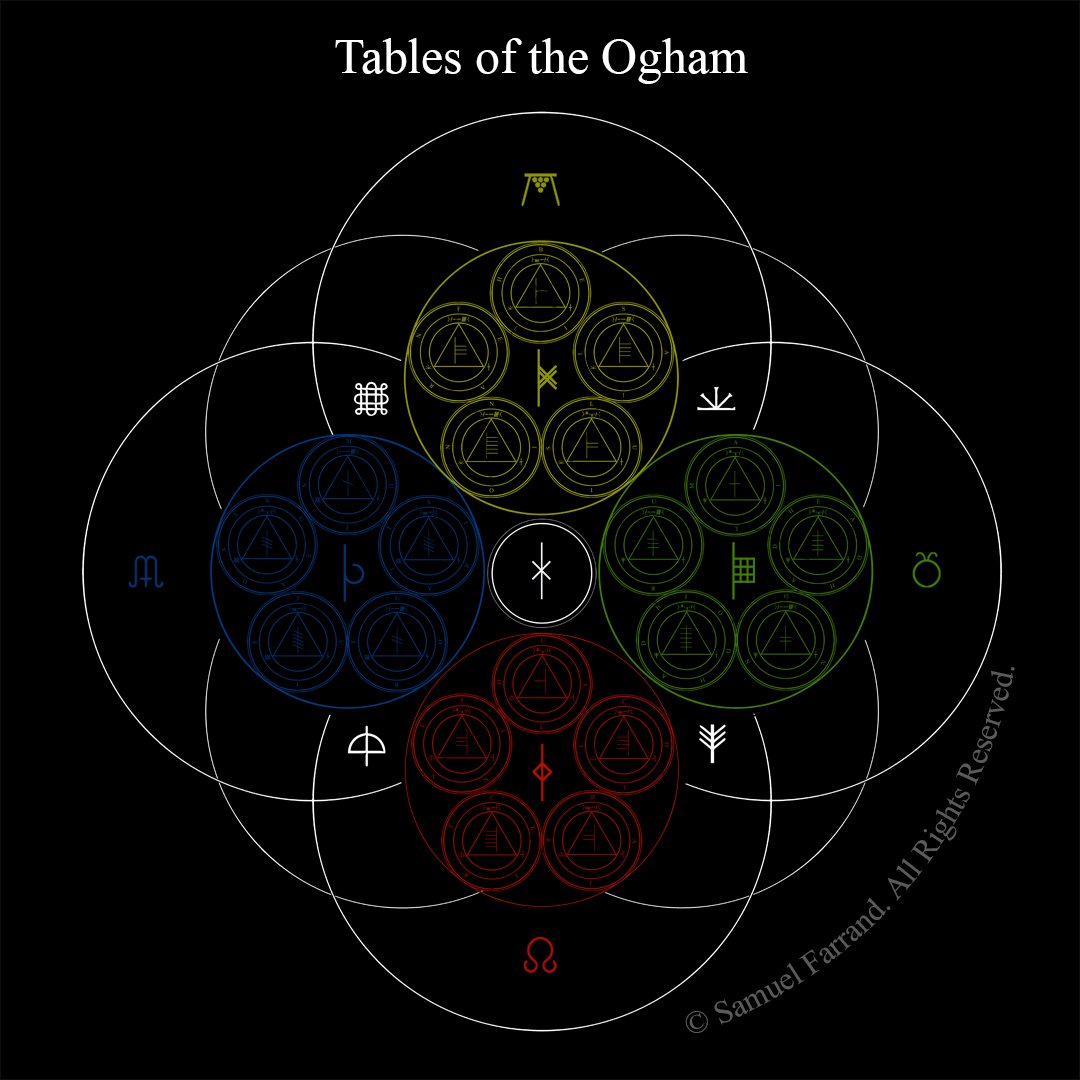
This table of correspondences presents Ogham as a unified magical system, one that reveals the Celtic alphabet not merely as a sequence of letters, but as a living cosmological structure capable of standing in dialogue with the wider Western esoteric tradition. Traditionally, Ogham is divided into four Aicmes, with a fifth introduced around 964 AD as a later elaboration of the original system. Each Aicme contains five individual letters known as a Few, and each Aicme takes its name from the first few within it. What emerges from this structure is not just an alphabetic arrangement, but a layered symbolic framework that lends itself naturally to magical, seasonal, and cosmological interpretation.
In this system, the four primary Aicmes are aligned with the four ancient Celtic seasonal midpoints: Imbolc, Beltane, Lughnasadh, and Samhain. From this foundation, each Aicme can be understood more broadly through its relation to the solstices and equinoxes, allowing the Ogham system to expand into a fuller ritual calendar. Each Aicme is assigned a color that mirrors one of the four classical elemental currents, creating a visual resonance between Celtic seasonal cosmology and the elemental structures familiar within Western esotericism, without asserting a direct equivalence between the two traditions.
Within each Aicme, the five fews are arranged according to a sequence that mirrors the elemental logic of the pentagram. The first few reflects Spirit, the second Fire, the third Air, the fourth Water, and the fifth Earth, following the same sequence used in traditional pentagram invocations. If we examine Aicme Beith, represented here in yellow, and understand that it carries an Air resonance, then the pattern becomes clear: Beith becomes the Spirit of Air, the second letter reflects the Fire of Air, the third the Air of Air, the fourth the Water of Air, and the fifth the Earth of Air. The same pattern extends through each of the Aicmes, allowing every grouping to unfold as its own internal elemental house without requiring explicit elemental labeling.
At the center of each Aicme is placed one of the five letters of the fifth Aicme, the Forfedha. Because its historical introduction as a later addition to the alphabet places it outside the fourfold structure of the original four Aicmes, the Forfedha reflects naturally the position of Spirit within the system. One of its five letters is therefore placed at the center of each Aicme to extend the structural logic into a fifth principle, bringing the diagram into closer alignment with a Celtic cosmological orientation. Koad, the first Forfedha, occupies the center of the entire diagram as the Spirit of Spirit, establishing the spiritual axis from which all other resonances unfold.
Each individual few is given a further symbolic architecture. The few is placed at the center of a triangle, a form that reflects the threefold order found across numerous expressions of Celtic thought and symbolism. At the three points of this triangle are three additional correspondences drawn from the Celtic cosmological tradition: at the top is one of the three Celtic realms, Tír (Land), Muir (Sea), or Nem (Sky); at the bottom right is the Aicme to which the few belongs; and at the bottom left is one of the four traditional Pagan sabbats. Around the outer ring, the name of the few is spelled out in full, completing the symbolic enclosure of the letter within its wider network of meaning.
Taken as a whole, this diagram proposes Ogham as more than a linguistic relic or divinatory tool. It presents the alphabet as a complete magical matrix, one capable of integrating Celtic cosmology, seasonal rites, structural elemental resonance, and esoteric logic into a single visual system. In doing so, it offers practitioners a comprehensive guide to Celtic divination and cosmology, while positioning Ogham within a broader magical continuum that reaches across the Western esoteric tradition. The elemental logic embedded here is not imposed upon the Ogham but perceived within it, a pattern latent in the structure of the alphabet itself, revealed through color, sequence, and seasonal alignment.
Explore More from this Series →

Leave a Reply