
Tables of Ginnungagap
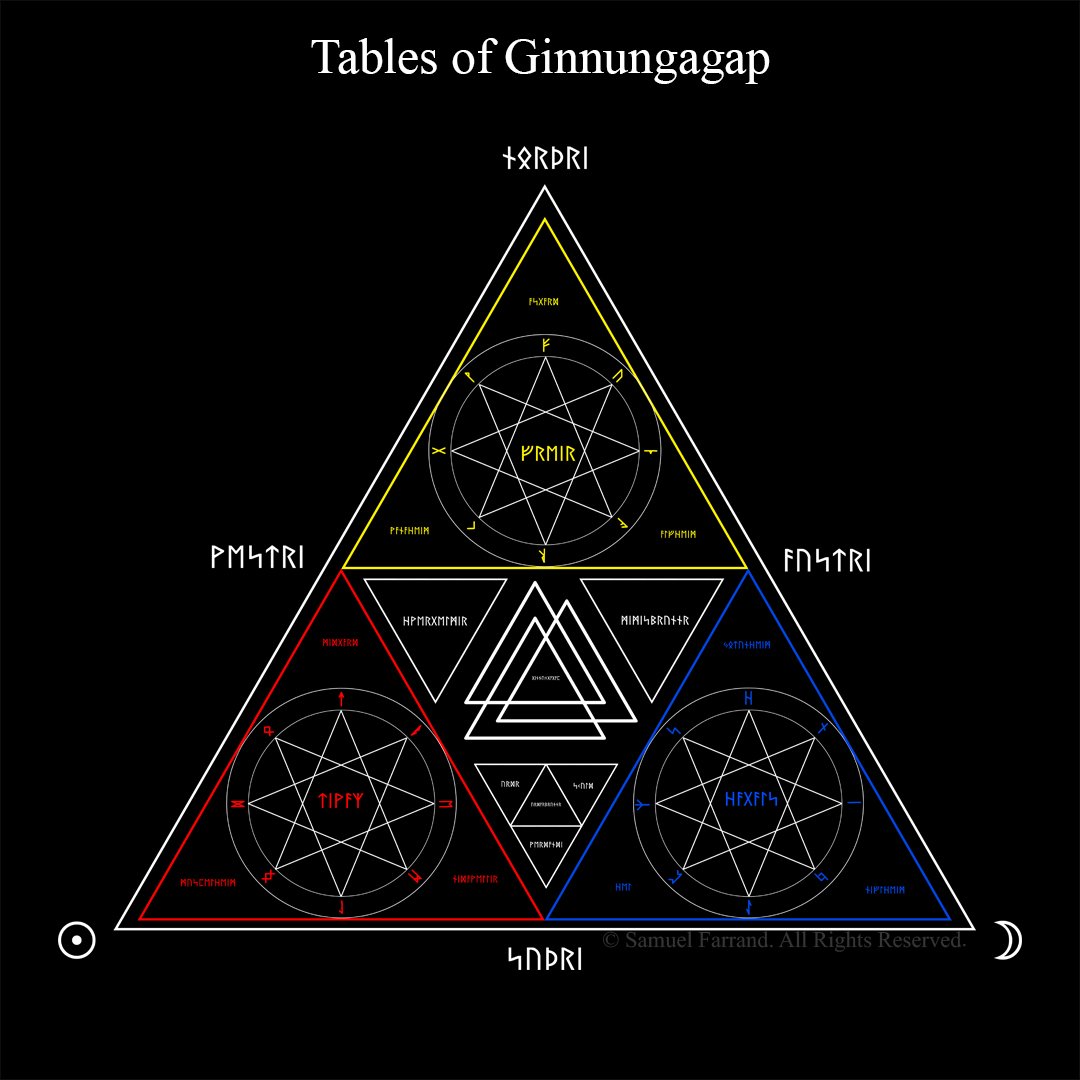
This correspondence table is a reconstructed cosmological diagram that brings traditional Norse concepts into a single unified visual system. Rooted in the architecture of ancient Norse cosmology, the piece begins at the void of Ginnungagap, the primordial gap from which all things emerge. Because Ginnungagap stands as the originating condition of creation, it occupies the very center of the composition as the source from which the entire structure unfolds.
From this center, the diagram expands through the form now commonly called the valknut, an enigmatic symbol found in connection with Viking Age material culture, including carved stones, objects, and funerary imagery. Although the modern name itself is not ancient, the symbol serves here as a powerful structural device. Its interlocking triangles are used to signify the three roots of Yggdrasil, the world tree, extending outward into the deeper framework of the cosmos. From this arrangement emerge three additional triangular forms representing the three wells associated with Yggdrasil. At the base lies Urðarbrunnr, the Well of Urdr, where the three Norns are situated as keepers of fate and becoming.
Beyond this central structure, the composition opens into three color-coded triangular realms, each containing a triadic division of the nine worlds. Asgard, Alfheim, and Vanaheim are placed within the realm of Air. Midgard, Muspelheim, and Nidavellir are placed within the realm of Fire. Jotunheim, Niflheim, and Hel are placed within the realm of Ice. This specific elemental arrangement is a contemporary reconstruction rather than a direct medieval schema, yet it was developed in a way that remains sympathetic to the spirit of Norse cosmology. It also aligns coherently with the three ættir, with Freyr’s ætt corresponding to Air, Tyr’s ætt to Fire, and Hagal’s ætt to Ice. Each realm is further reinforced by the runes assigned to its corresponding ætt, allowing the diagram to operate not only as cosmology, but as a system of symbolic correspondence.
Surrounding these inner structures are the four cardinal directions, each named for the directional dwarves of Norse myth: Nordri in the North, Sudri in the South, Austri in the East, and Vestri in the West. Completing the outer field are the glyphs of Sol and Mani, the sun and moon, placed as cosmological markers that further reinforce the polarity and balance embedded within the structure.
Taken as a whole, The Tables of Ginnungagap is not presented as a strict historical recovery of a lost Norse diagram, but as a careful reconstruction. It seeks to organize Norse cosmological material into a unified magical and symbolic table that can stand in conversation with the broader Western esoteric tradition, while remaining honest about where the Eddic material ends and where interpretation begins.
Explore More from this Series →

Leave a Reply