
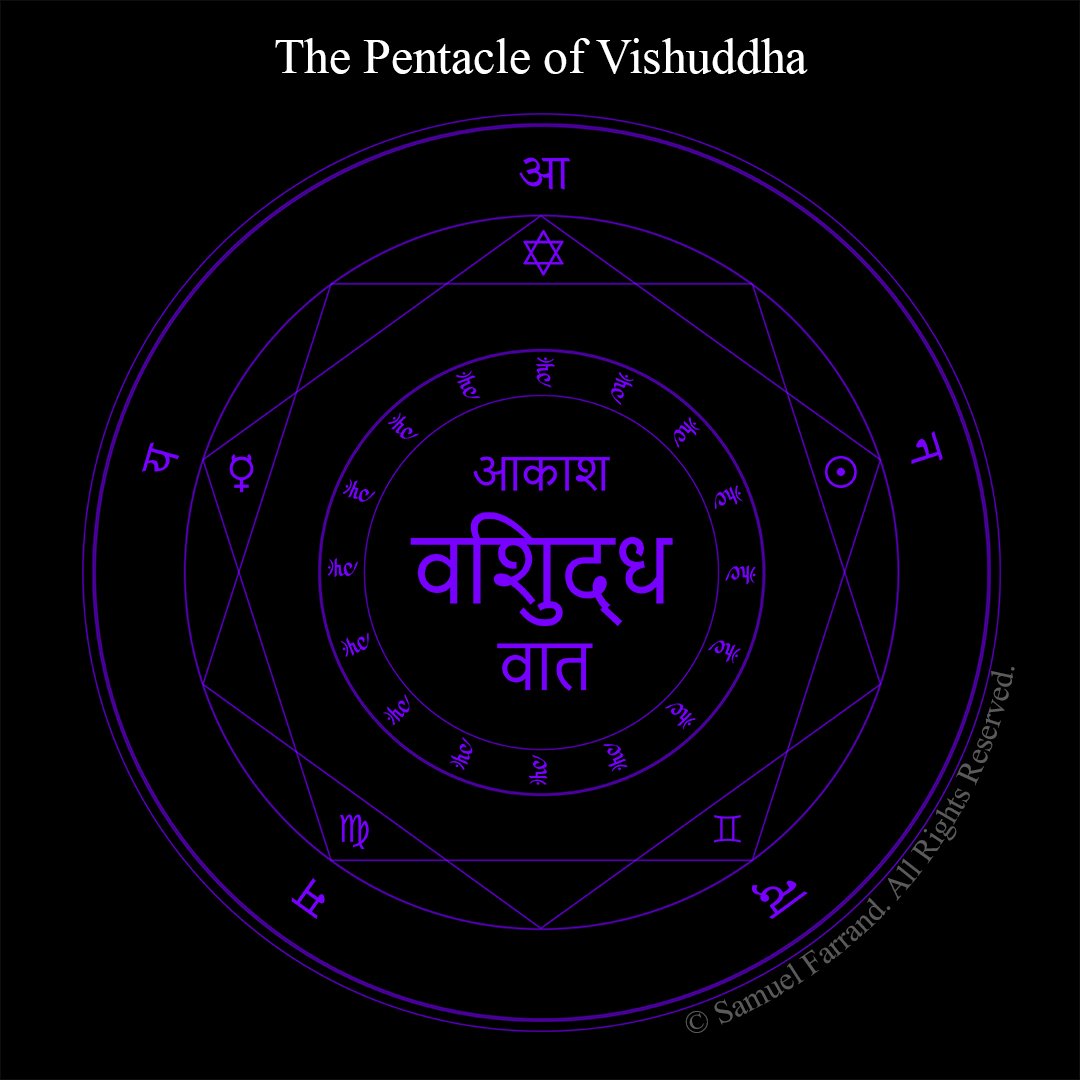
Vishuddha Correspondences in the Panchachakras: Akasha, Mercury, Vata, Anandamaya, Gemini, Virgo, and Shabda
The Table of the Panchacakras maps the five classical elements of Sanskrit philosophy onto a unified correspondence system drawing from Ayurvedic medicine, Upanishadic philosophy, classical Western astrology, and Kashmir Shaivism. Five chakra seals surround a central Sri Yantra within a ring of 36 Tattvas tracing the full emanation from pure Shiva consciousness to gross earth. Vishuddha is the fifth and final seal, governing Ether, the element that contains and precedes all other elements, the subtle space from which the four gross elements emerge and into which they return.
Vishuddha means Especially Pure in Sanskrit. The name carries the sense of something refined beyond the ordinary degrees of refinement, purified past the threshold where purification produces a different category of thing rather than merely a cleaner version of the same thing. It is the chakra most associated with authentic expression, with the capacity to give outer form to inner truth without distortion, and with the experience of consciousness operating at the boundary between the personal and the transpersonal. Where the four chakras below it govern the four domains of embodied human experience, Vishuddha governs the place where that experience opens onto something larger than itself.
The governing Tattva is Akasha, Ether, rendered here in indigo-black, the traditional color of the Akasha Tattva symbol, an oval representing the void, the dark plenum from which all sound and therefore all differentiation emerges. Akasha is the most subtle of the five elements, the one that is not itself a quality but the space within which all qualities arise. It is the element of sound not as vibration in air but as the primordial differentiation by which undifferentiated consciousness first begins to take on character and form. Its Tanmatra is Shabda, sound, the most subtle and universal of the five senses, the one that operates across the greatest distances and carries meaning in its most immaterial form.
The governing planet is Mercury, the planet of language, transmission, mediation, and the movement of meaning between realms. Mercury in both Greek mythology and Vedic astrology is the messenger, the only principle that moves freely between all levels of reality. At the throat chakra, Mercury as the governing planet describes communication not merely as the transfer of information but as the act of bridging the invisible interior and the visible exterior, of making the formless take form in language and sound. The spoken word is where inner truth either remains true or loses itself in translation. Mercury governs that threshold.
The governing dosha is Vata, shared with Anahata, since Vata is composed of both Air and Ether. At the heart, Vata expresses as the moving, circulating quality of relational love. At the throat, Vata expresses as the subtle, mobile, and all-pervasive quality of Ether itself: the lightness of consciousness approaching its own ground, the quality of awareness that is beginning to perceive the space it is made of rather than only the objects that appear within that space.
The governing Kosha is Anandamaya, the bliss body, the subtlest of the five sheaths, the one closest to pure consciousness before the sheaths dissolve entirely. Ananda in Sanskrit means bliss, not in the casual sense of pleasure or happiness, but the intrinsic quality of pure awareness itself, the fact that consciousness in its natural state, prior to contraction and conditioning, is experienced as an unconditional fullness. Placing Anandamaya at Vishuddha means the threshold between the personal self and pure awareness is located at the throat, at the place of authentic expression, at the point where what is most true in a person meets the world as sound.
The zodiacal signs Gemini and Virgo are both classical Mercury rulerships. Gemini carries Mercury’s communicative, connective, and multiplying face: the mind that moves quickly between perspectives, that is nourished by exchange, that finds meaning in the relationship between ideas. Virgo carries Mercury’s more discerning, precise, and service-oriented face: the intelligence that refines, that distinguishes what is essential from what is not, that serves truth through careful attention to what is actually the case. Both aspects are present in Vishuddha: the transmission of meaning between inner and outer and the precision that keeps that transmission honest.
The Sun governs the upper two chakras through the nature of conscious outward experience, and at Vishuddha that solar quality reaches its fullest expression within the five chakra system. If the heart is where consciousness turns outward in love, the throat is where it speaks what it has found. The spoken word as the deliberate transmission of inner meaning into outer form is the most fully solar act available to the embodied human being. It is the self choosing to make itself known, choosing to give form to what is formless within it, choosing to let what is true inside become audible outside.
Vishuddha is the spirit threshold of the Table of the Panchacakras. Every correspondence it carries points to the same place: the boundary between the human and the transpersonal, between what can be contained in a self and what exceeds all containment. The element that contains all other elements. The planet that moves between all worlds. The Kosha that borders pure consciousness. The sense that carries meaning in its most immaterial form. Vishuddha is where the descent of the 36 Tattvas from pure Shiva consciousness finally arrives at its most subtle embodied expression, and where the path of return most naturally begins.
This pentacle forms part of Occultum Lapidem, a body of esoteric correspondence work conceived as a companion to the Da’ath Tarot, the first divinatory deck to express tarot wholly through symbol and correspondence.
