
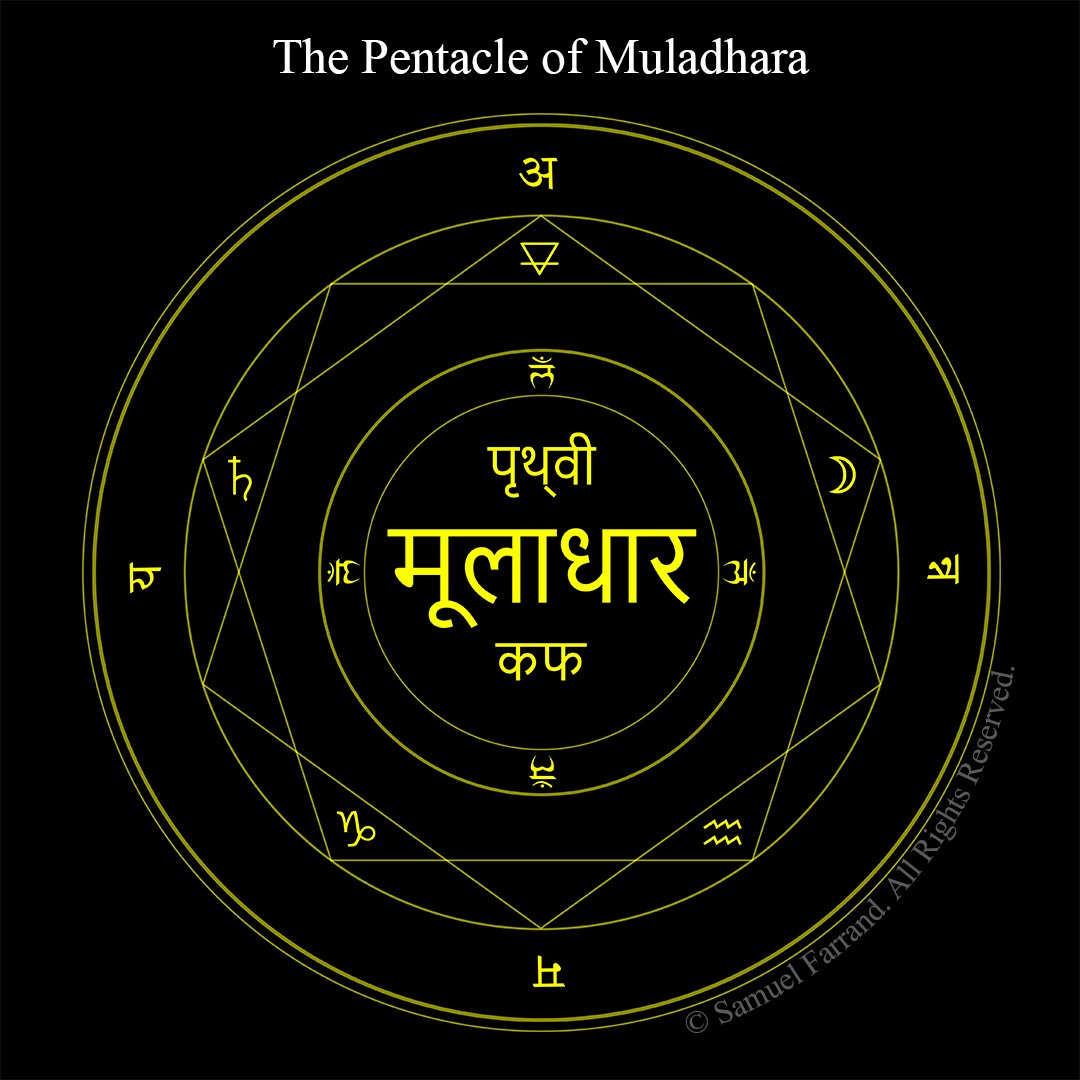
Muladhara Correspondences in the Panchachakras: Prithvi, Saturn, Kapha, Annamaya, Capricorn, Aquarius, and Gandha
The Table of the Panchacakras is a cosmological correspondence diagram unifying Eastern and Western esoteric traditions around the five classical elements of Sanskrit philosophy. Five chakra seals, each governing one element, one planet, one dosha, and one Kosha sheath of the self, surround a central Sri Yantra within a ring of 36 Tattvas tracing the full emanation from pure Shiva consciousness down to gross earth. Muladhara is where that descent arrives. It is the terminal point of the emanation sequence, the place where consciousness has traveled the full distance from pure undifferentiated awareness into the densest possible expression of itself as matter.
Muladhara means Root Support in Sanskrit, and the name is precise. It is the foundation upon which the entire energetic system of the human being rests. Without a stable root, nothing above it can function. The traditions that placed the first chakra at the base of the spine were not arranging a hierarchy of value. They were describing a structural reality: dense matter is the ground of embodied existence, and the relationship a person has with their own embodiment determines the stability of every more subtle layer of experience above it.
The governing Tattva is Prithvi, Earth, rendered here in yellow, the traditional color of the Prithvi Tattva symbol, a square representing solidity, the right angle, the fixed and reliable form. Earth is the element that holds shape, that resists dissolution, that provides the surface upon which all other activity takes place. Its Tanmatra, the subtle elemental essence that precedes it in the emanation sequence, is Gandha, smell, the most instinctual and memory-laden of the five senses, the one most directly wired to the oldest structures of the brain, the one that bypasses conscious thought and lands immediately in the body.
The governing planet is Saturn, the outermost of the five classical planets and the one most associated in both Eastern and Western traditions with density, contraction, limitation, and time. Saturn is the principle that gives form its edges, that makes matter matter by preventing it from dissolving back into formlessness. In Hermetic tradition Saturn governs the densest tier of material existence. In Vedic astrology Shani carries similar weight, the planet of karma, of consequence, of the structures that outlast individual will. Saturn at the root is the planet in precisely the position its nature demands.
The governing dosha is Kapha, the Ayurvedic principle composed of Earth and Water, the dosha of structure, stability, cohesion, and endurance. Kapha is what holds the body together, what gives tissue its density and bones their solidity. It is the biological expression of the same principles Saturn and Prithvi represent at the cosmic and elemental levels. The three layers, planetary, elemental, and biological, are saying the same thing in three different vocabularies.
The governing Kosha is Annamaya, literally the food body, the gross physical sheath, the outermost and most material layer of the self in the Upanishadic model of consciousness. Annamaya is the body that is built from what is eaten, that returns to earth at death, that is fully subject to the laws of matter. Placing Annamaya at Muladhara completes the correspondence with structural exactness. The most material Kosha governs the most material chakra.
The zodiacal signs Capricorn and Aquarius are both classical Saturn rulerships, and their placement here follows the planetary assignment without deviation. Capricorn carries Saturn’s earthbound, disciplined, structural face. Aquarius carries Saturn’s more austere and principle-governed face, the willingness to hold form in service of a larger order. Both aspects of Saturn are present in the root: the physical structure of the body and the karmic architecture that determines the conditions of embodied life.
The Moon governs the lower two chakras of this system through the nature of the experience they represent. Muladhara and Svadhisthana operate in the domain of the subconscious, of processes that precede and underlie awareness, of the tidal forces that move in a person before that person has any language for what is moving. This is lunar territory in its deepest sense. The Moon governs what is hidden, what is instinctual, what rises from beneath the threshold of deliberate thought. The root chakra is the deepest point of that territory.
Muladhara is the place in the human energetic system where Shiva finished descending. It is the furthest point from pure consciousness in the emanation sequence and the necessary starting point for the journey of return. Every tradition that maps the spiritual path begins here, with the body, with the earth, with the willingness to be fully present in the densest layer of existence before attempting to move through the subtler ones. The root is not the lowest rung of a ladder to be left behind. It is the ground from which everything grows.
This pentacle forms part of Occultum Lapidem, a body of esoteric correspondence work conceived as a companion to the Da’ath Tarot, the first divinatory deck to express tarot wholly through symbol and correspondence.
