
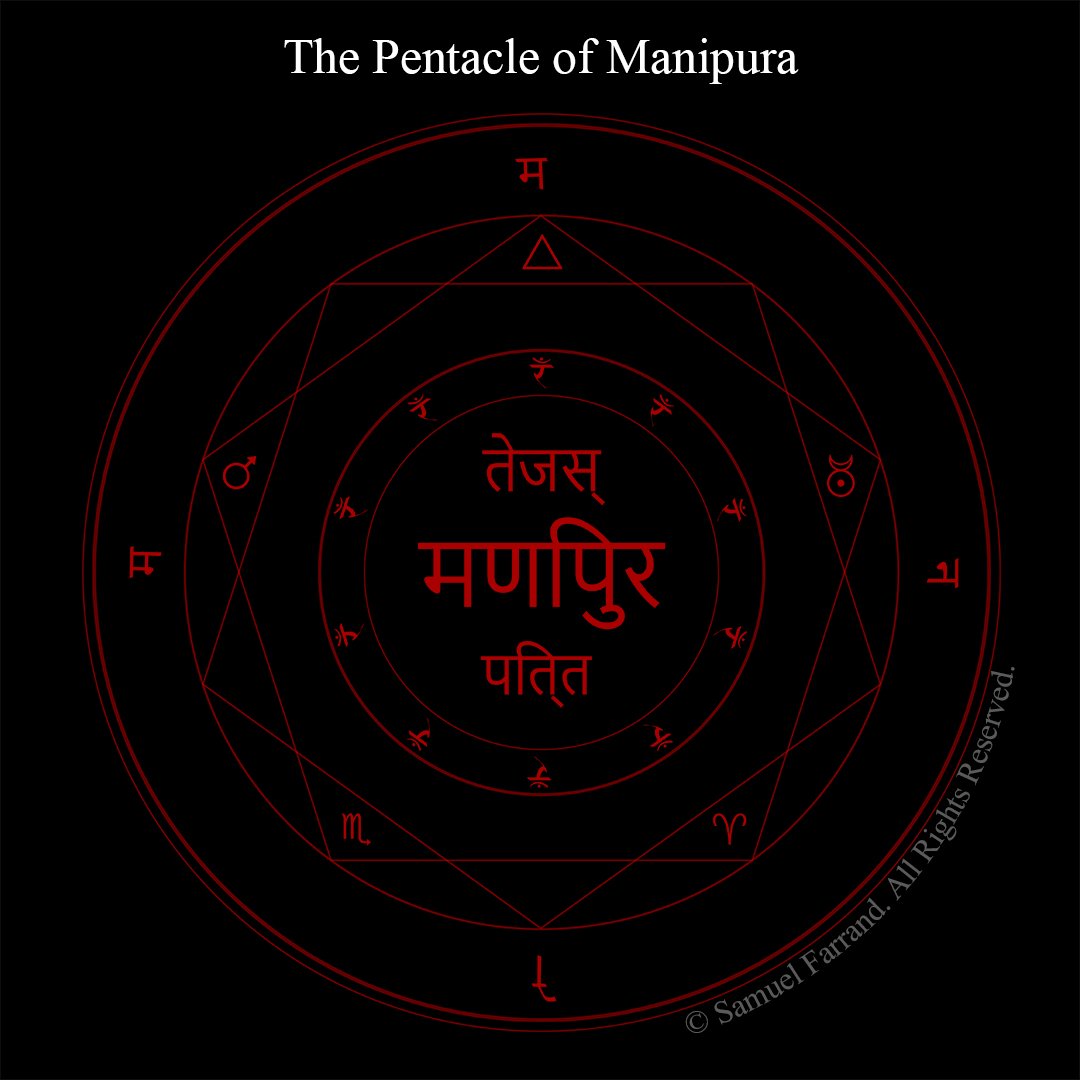
Manipura Correspondences in the Panchachakras: Tejas, Mars, Pitta, Manomaya, Aries, Scorpio, and Rupa
The Table of the Panchacakras maps the five classical elements of Sanskrit philosophy onto a unified correspondence system drawing from Ayurvedic medicine, Upanishadic philosophy, classical Western astrology, and Kashmir Shaivism. Five chakra seals surround a central Sri Yantra within a ring of 36 Tattvas tracing the full emanation from pure Shiva consciousness to gross earth. Manipura is the third seal, the center of the five, governing Fire, the element of transformation, will, and the metabolic force that turns raw material into directed energy.
Manipura means City of Jewels in Sanskrit. The name carries the sense of something radiant, concentrated, and multiply faceted, a place of brightness at the center of the body’s energetic map. It is the chakra most associated with personal power, with the capacity to act from a clear center, with the digestion of experience into wisdom, and with the autonomous will that operates independently of external validation. Where Muladhara establishes the ground and Svadhisthana introduces the flow of life through that ground, Manipura ignites. It is the point at which matter becomes energy, at which the raw materials of existence are burned into capacity and directed force.
The governing Tattva is Tejas, Fire, rendered here in red, the traditional color of the Tejas Tattva symbol, an upward pointing triangle whose very geometry enacts the principle it represents: fire rising, aspiring, converting the dense into the subtle. Fire is the element that transforms everything it touches, that cannot be held or contained indefinitely, that consumes in order to release, that illuminates by burning. Its Tanmatra is Rupa, form and sight, the sense most associated with clarity, discrimination, and the capacity to perceive the world as it actually is rather than as feeling or instinct suggest it to be.
The governing planet is Mars, the planet of drive, decisive action, and the principle of directed force. Mars in both Western and Vedic traditions governs the will that cuts through obstruction, the energy that initiates rather than waits, the courage that acts from inner conviction regardless of external circumstance. At the solar plexus, Mars as the governing planet describes the relationship between personal power and personal agency: the capacity to act from one’s own center without being driven by the unconscious forces of the two chakras below or pulled toward the relational demands of the two chakras above. Manipura governed by Mars is pure autonomous will.
The governing dosha is Pitta, the Ayurvedic principle composed of Fire alone, the dosha of transformation, digestion, metabolism, and the sharp discriminating intelligence that separates what serves from what does not. Pitta is the biological fire that processes food into energy, experience into understanding, and raw sensation into usable information. It governs the liver, the digestive fire, the capacity for focus and precision. Placing Pitta at Manipura creates a triple confirmation: the elemental, the planetary, and the biological all pointing to the same principle of transformative, directed, metabolic fire at the center of the system.
The governing Kosha is Manomaya, the mental body, the sheath of ordinary mind and sensory processing that organizes the raw data of experience into recognizable patterns. Manomaya is where perception becomes thought, where sensation becomes concept, where the world outside becomes the inner map by which a person navigates. Placing Manomaya at Manipura is philosophically exact: the fire of discrimination and the mental capacity for organizing reality into meaning belong to the same tier of the self.
The zodiacal signs Aries and Scorpio are both classical Mars rulerships. Aries carries Mars’s initiating, direct, outward-moving force, the energy of the beginning, the impulse that moves before it calculates. Scorpio carries Mars’s deeper, more hidden, and more transformative face, the will that operates beneath the surface, that is willing to descend into what is most difficult in order to emerge changed. Both aspects are present in Manipura: the direct force of personal agency and the depth of transformative will.
Manipura stands alone in this system as the chakra belonging to neither luminary. The Sun and Moon govern the lower two and upper two chakras respectively through the nature of the conscious and subconscious experiences they represent. Manipura is the bridge and the transformer between those two domains. It is the crucible in which the subconscious drives of the lower body are metabolized into the conscious expressions of the upper. The autonomous will does not belong to the Moon because it is not unconscious, and it does not yet belong to the Sun because it has not yet turned outward in love or speech. It belongs to itself, which is precisely what personal power means.
This pentacle forms part of Occultum Lapidem, a body of esoteric correspondence work conceived as a companion to the Da’ath Tarot, the first divinatory deck to express tarot wholly through symbol and correspondence.
