
Anahata Correspondences in the Panchachakras: Vayu, Venus, Vata, Vijnanamaya, Taurus, Libra, and Sparsha
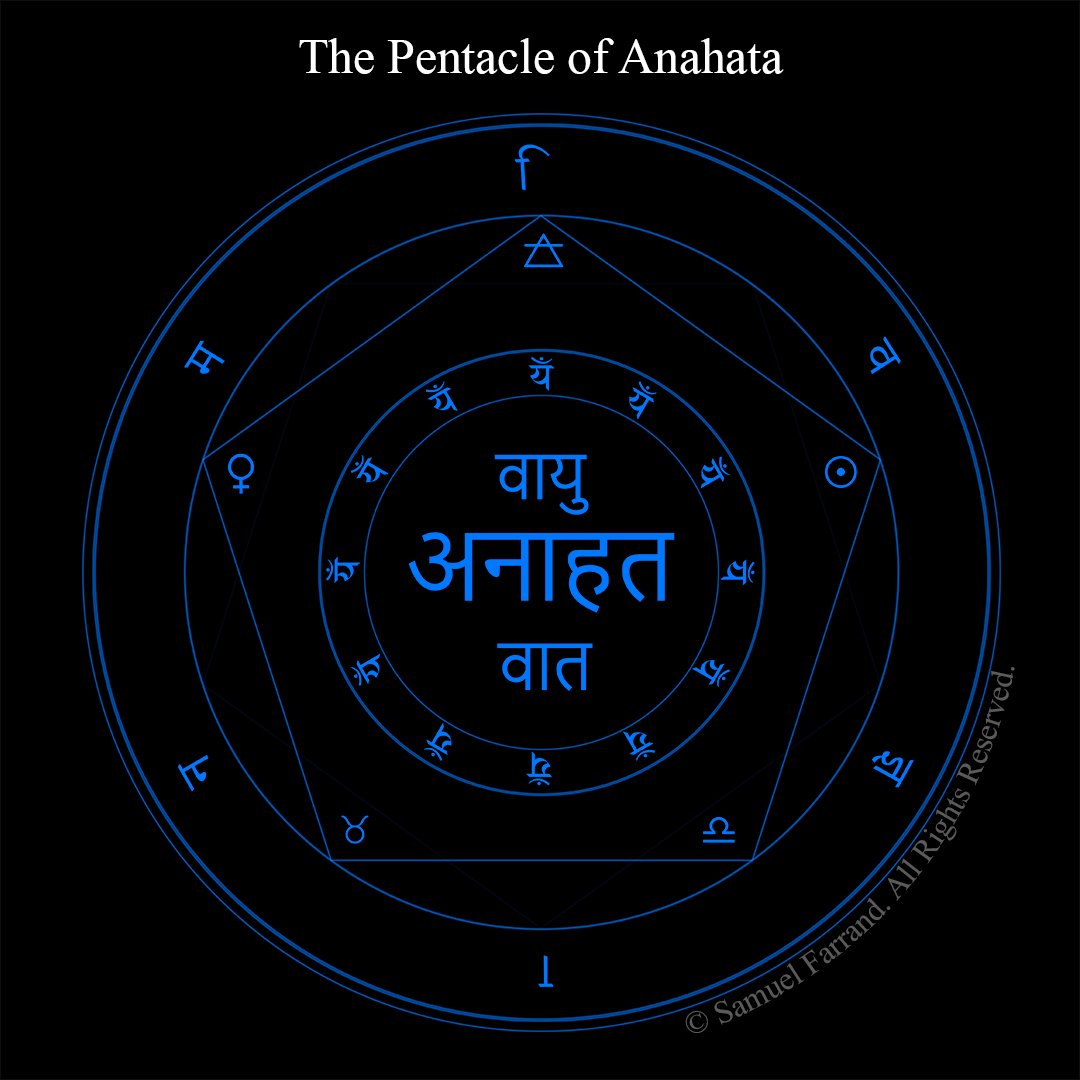
The Table of the Panchacakras maps the five classical elements of Sanskrit philosophy onto a unified correspondence system drawing from Ayurvedic medicine, Upanishadic philosophy, classical Western astrology, and Kashmir Shaivism. Five chakra seals surround a central Sri Yantra within a ring of 36 Tattvas tracing the full emanation from pure Shiva consciousness to gross earth. Anahata is the fourth seal, governing Air, the element of movement, relationship, and the space through which connection becomes possible.
Anahata means Unstruck in Sanskrit, a reference to the mystical sound that exists without two things striking together, the primordial vibration that underlies all audible sound, the hum of existence before it differentiates into particular frequencies. The name points toward something that is already present before any cause produces it, a love and an openness that exists prior to the conditions that might justify it. It is the chakra most associated with the capacity for genuine connection, with compassion as a structural feature of consciousness rather than a response to circumstances, and with the experience of beauty as a form of perception rather than merely a preference.
The governing Tattva is Vayu, Air, rendered here in blue, the traditional color of the Vayu Tattva symbol, a circle whose boundless and centerless geometry enacts the nature of air itself: omnidirectional, without fixed edges, present everywhere simultaneously. Air is the element that connects, that carries, that makes the distance between things permeable. It is the medium of breath, of voice, of the invisible currents that move between living things. Its Tanmatra is Sparsha, touch, the sense of contact, of the boundary between self and other becoming a place of meeting rather than a wall of separation.
The governing planet is Venus, the planet of love, beauty, harmony, and the relational principle in its fullest expression. Venus governs the recognition of beauty in the other, the capacity for appreciation that is also a form of love, the aesthetic sensitivity that is trained by the heart rather than the mind. At the heart chakra, Venus as the governing planet describes love as a mode of perception, a way of seeing that reveals the significance of what it falls upon.
The governing dosha is Vata, the Ayurvedic principle composed of Air and Ether, the dosha of movement, lightness, creativity, and the subtle pervasive quality of wind through a living system. Vata governs the nervous system, the circulation of prana through the channels, the quick movements of thought and sensation that constitute moment to moment experience. At the heart, Vata as the governing dosha describes love as a moving, circulating, non-fixed force: not the heavy cohesion of Kapha or the sharp focus of Pitta, but the light and pervasive quality of something that moves through everything and connects everything it moves through.
The governing Kosha is Vijnanamaya, the wisdom or discernment body, the sheath of higher intelligence that lies beneath ordinary mental processing. Where Manomaya at Manipura organizes perception into thought, Vijnanamaya at Anahata recognizes the significance of what thought has organized. It is the layer of the self that understands rather than merely processes, that knows rather than merely knows about. Placing Vijnanamaya at the heart means that genuine understanding is a function of the heart’s intelligence, that wisdom arises when the mind is informed by the depth of the feeling self.
The zodiacal signs Taurus and Libra are both classical Venus rulerships. Taurus carries Venus’s more earthy, sensory, and appreciative face: the love of beauty as it manifests in the physical world, the pleasure of the body, the deep satisfaction of the senses in contact with what they find beautiful. Libra carries Venus’s more relational, harmonizing, and justice-seeking face: the love that weighs, that seeks balance, that is as aware of the other’s experience as of its own. Both aspects are present in Anahata: the appreciation of beauty as a form of love and the relational intelligence that holds two beings in genuine regard for each other.
The Sun governs the upper two chakras through the nature of conscious outward experience, and at Anahata its presence marks the beginning of that solar domain. Love as a chosen orientation, as something a person decides to bring to their encounter with the world rather than something that merely happens to them, is the first fully solar experience in the system. It is the heart opening as an act, as a way of being present to another that is conscious of itself. This is where the system crosses from the lunar into the solar, from what moves in us to what we direct outward from ourselves.
This pentacle forms part of Occultum Lapidem, a body of esoteric correspondence work conceived as a companion to the Da’ath Tarot, the first divinatory deck to express tarot wholly through symbol and correspondence.
