 Samuel Farrand OfficialSamuel Farrand OfficialSamuel Farrand Official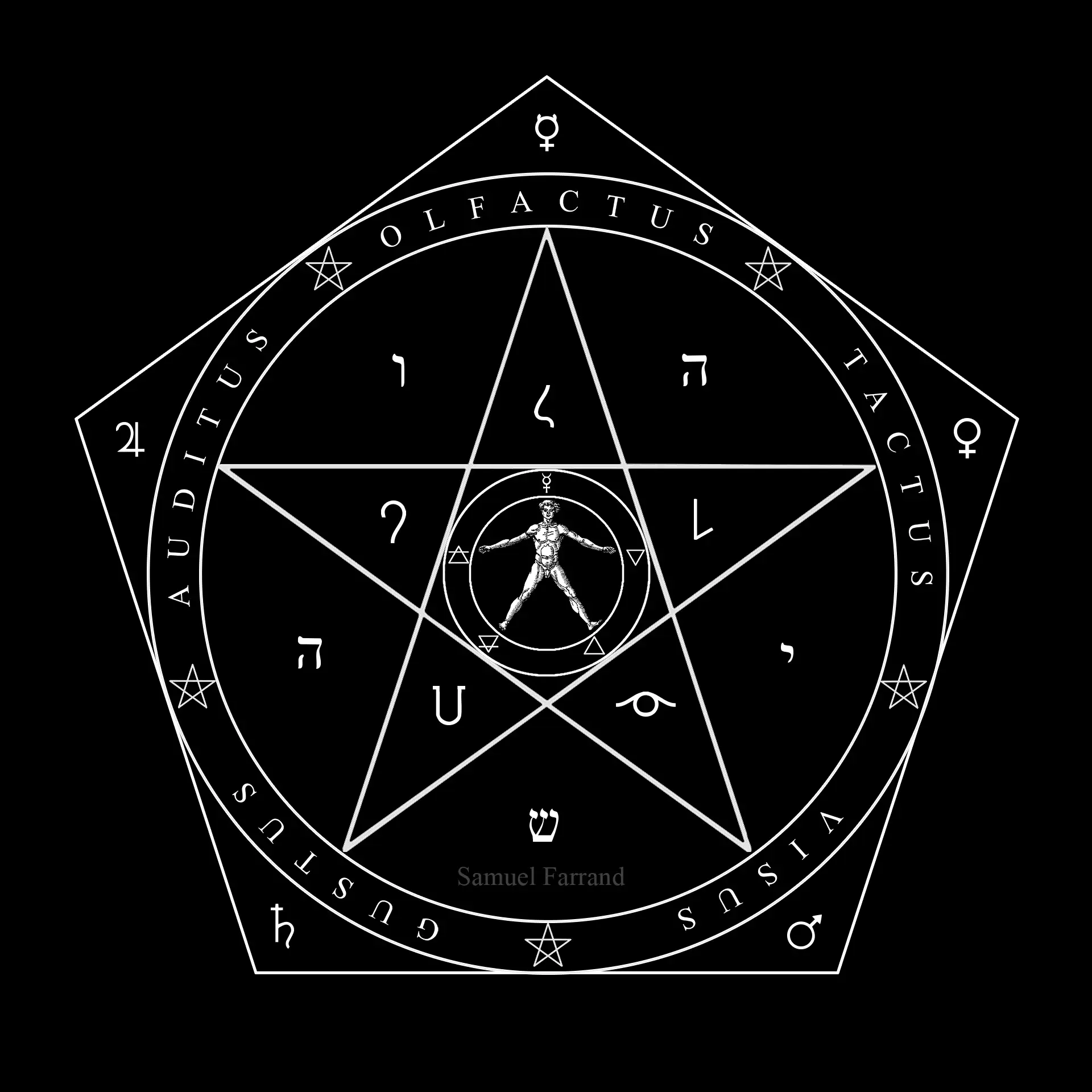
This diagram began as a correspondence map of the five senses, but quickly became an exercise in restraint, lineage, and fidelity to classical systems. Because no historical glyphs exist for the five senses, I designed a new set from scratch, adhering to the same visual discipline found in Renaissance-era astrological and alchemical correspondence glyphs. The goal was not invention for its own sake, but continuity, forms that could plausibly belong within the Western esoteric canon.
The primary inspiration for this work comes from Cornelius Agrippa’s Second Book of Occult Philosophy, specifically the Scale of Five and the well-known illustration of the pentagrammatic man placed at the center of the cosmos. In Agrippa’s original diagram, the five visible planets, Mars, Jupiter, Saturn, Mercury, and Venus, occupy the points of the pentagram, while the Moon and Sun sit outside and inside the figure respectively. Together, they form the seven classical planets and express the core hermetic principle of microcosm and macrocosm, as above, so below.
In keeping with the ontological purity of Agrippa’s Scale of Five, I preserved his planetary structure while making a necessary adjustment to elemental assignments. Agrippa assigns Water and Earth to Saturn and Venus in a way that conflicts with later Western astrological traditions. To reconcile these systems without breaking either, I reassigned Saturn to Earth and Venus to Water. This single correction allows Agrippa’s fivefold planetary logic to remain intact while aligning cleanly with Western astrology. All other planetary assignments were left unchanged.
The result is a coherent correspondence map linking the five senses to planets and elements, which can then be extended naturally into zodiacal and tarot associations. Once these relationships are stabilized, they reveal a remarkably clean framework that bridges multiple symbolic systems without contradiction.
A second challenge emerged around the elemental attribution of the pentagram itself. To preserve traditional ritual practice and remain faithful to the Kabbalistic Four Worlds, I assigned the pentagram points clockwise from the top as Spirit, Water, Fire, Earth, and Air. This maintains the structure used in traditional pentagram invoking rituals. When read counterclockwise beginning at Fire, the sequence aligns precisely with the Kabbalistic worlds: Atziluth for Fire, Briah for Water, Yetzirah for Air, and Assiah for Earth.
This structure is further reinforced through Hebrew symbolism. Counterclockwise, the letter Shin represents Spirit, while the four-letter divine name corresponds to the four elements and the four Kabbalistic worlds, a relationship that maps directly onto the tarot court cards.
I created this diagram as a companion framework for my tarot deck, Aeon of Da’ath, adding dimensionality and depth to readings rather than replacing existing systems. More broadly, it reflects an ongoing investigation into how recurring numbers in nature shape human perception. Through repeated observation, the number five consistently emerges as a key mediator between consciousness and the physical world. Five senses, five points, five visible planets. It is the number through which reality is perceived, translated, and made intelligible.
This diagram is not meant to innovate recklessly, but to reveal what is already there, quietly holding the structure together. Explore more from this series →